

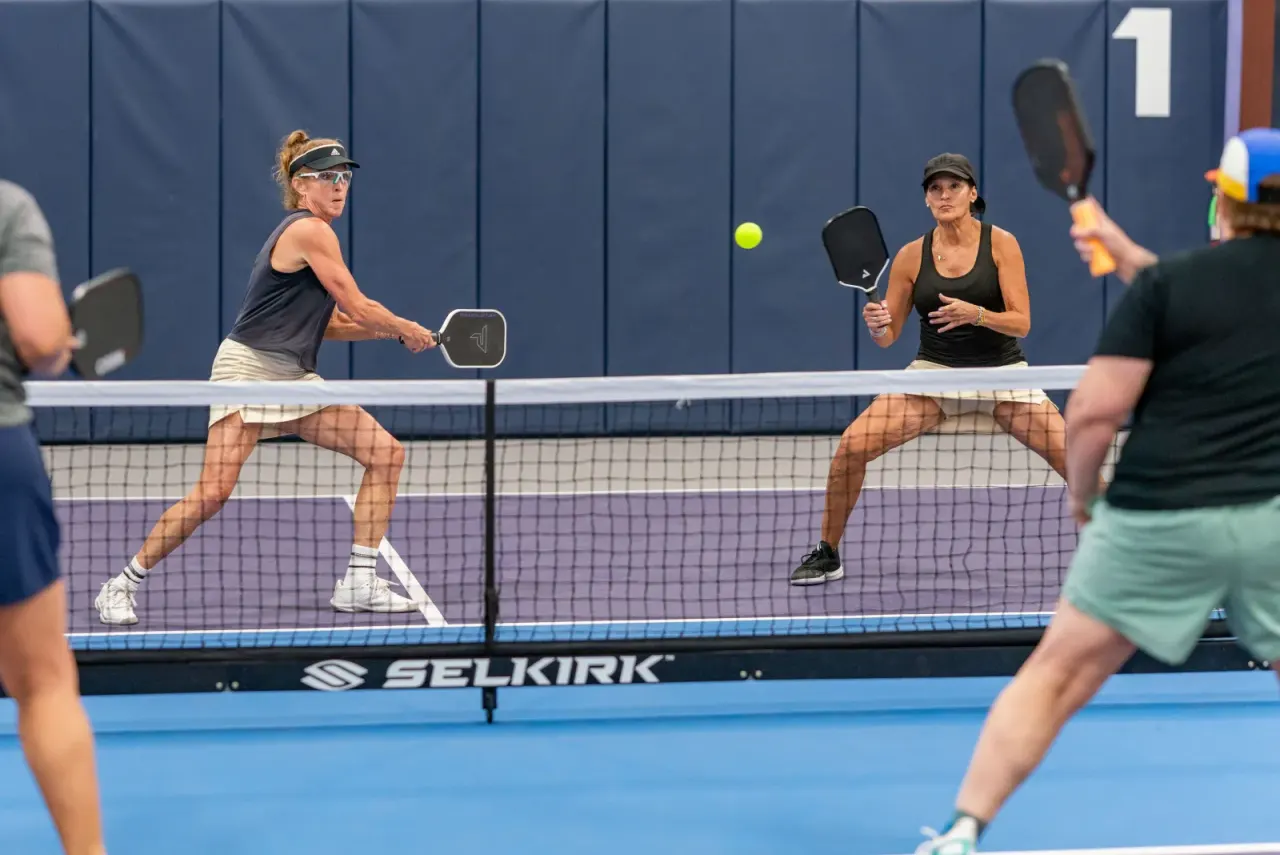
Poaching means crossing into your partner’s side of the court to take a ball they could have hit. Done well, it’s one of the most effective plays in doubles. Done impulsively, it opens a hole and costs you the point plus some goodwill.
The difference is almost entirely about which balls you cross on and whether your partner knew it was coming.
Which balls to poach
A floating ball above net height. The clearest poach. If a dink or drop pops up near the middle and you can take it out of the air above the net, cross and put it away.
A ball drifting toward the middle. Middle balls belong to whoever can take them more aggressively — usually the forehand. See who takes the middle.
When your partner is out of position. If they’re stuck deep or recovering, taking a middle ball is coverage, not poaching.
When you have a forehand and they’d have a backhand. A forehand poach on a ball your partner would meet with a backhand is usually the better shot for the team.
Which balls to leave
Anything below net height. If you cross and have to hit up, you’ve vacated your side to produce a defensive shot. Worst possible trade.
Balls your partner is already set for. Two paddles going for one ball is a fault if you both make contact — see pickleball double hit rules — and a collision risk regardless.
Wide balls on their sideline. You’ll never get there and you’ll leave a court-sized hole.
Anything when you’re already stretched. A poach off balance is a gift.
Communicate before, not during
Most poaching problems are communication problems. Options, in increasing order of formality:
Call it. “Mine” is enough, and it must come early — as the ball leaves your opponent’s paddle, not as you arrive. This is legal and normal; it’s partner communication, not a distraction.
Signal it. Some teams use a pre-point hand signal behind the back to indicate a planned poach on the return. Works well in leagues and tournaments.
Agree on defaults. The most useful and least used option. Before the game: “middle balls above the net are mine, low middle balls are yours.” Now you don’t need to call anything for most balls.
Cover behind yourself
The half of poaching people skip. When you cross, your side is empty — and your partner has to fill it.
The rule: your partner slides to where you left. If you poach right, they shift right behind you. You do not return to your original position; you continue into the space you moved toward and they take the space you vacated. The team rotates rather than swapping back.
This only works if both players know it in advance. Poaching without an agreed rotation is how you end up with both players on the same side of the court while the ball lands in the open half.
If your poach doesn’t end the point, you must keep moving through the rotation, not scramble back. Half a rotation is worse than none.
When poaching backfires
Poaching too often. It becomes predictable. Opponents start hitting behind you into the space you keep leaving, and every poach becomes a free point for them.
Poaching to be the hero. If you’re crossing because you want to hit the ball rather than because it’s the right shot, your partner will notice, and they’ll start hesitating on balls that are genuinely theirs. Hesitation costs more points than poaching wins.
Poaching on a low ball. Covered above and worth repeating — it’s the most common poaching error.
Not telling anyone. The collision risk is real, and paddles hurt.
Frequently Asked Questions
What does poaching mean in pickleball?
Crossing into your partner’s side of the court to hit a ball they could have played. It’s a legitimate and often strong doubles tactic when the ball and the timing are right.
When should you poach in pickleball?
On floating balls above net height near the middle, on balls drifting into the middle where you’d have a forehand and your partner a backhand, and when your partner is out of position.
Is poaching bad etiquette in pickleball?
Not inherently. It becomes a problem when it’s unannounced, frequent enough to be predictable, or done on balls your partner is already set to hit. Agree on defaults with your partner beforehand.
Who covers the court when you poach?
Your partner slides into the space you vacated while you continue through into the space you moved toward. The team rotates rather than each player returning to their original side.
Can you poach a ball below net height?
You can, but you generally shouldn’t. Crossing forces you to hit up from below the net, which produces a defensive ball while leaving your own side open.