
An overhead should be a free point. For most players it’s a coin flip, and the reason is almost never the swing — it’s the footwork before it.
Footwork first
Turn sideways immediately. The instant you read a lob, rotate so your shoulders are perpendicular to the net. Shuffling backward while facing the net is slow, unbalanced, and how people fall over.
Get behind the ball, not under it. The biggest error by far. If the ball is directly overhead you have to hit straight down with no margin. You want it slightly in front so you can drive up and through it.
Crossover step to move back, then shuffle to adjust. Point your non-paddle hand at the ball — it keeps your shoulders turned and helps you track it.
If you can’t get behind it, don’t smash. Let it bounce. A lob that gets over your head deep in the court is better played off the bounce than swatted at full stretch. Falling backward while swinging up sends the ball into the net or over everything.
The swing
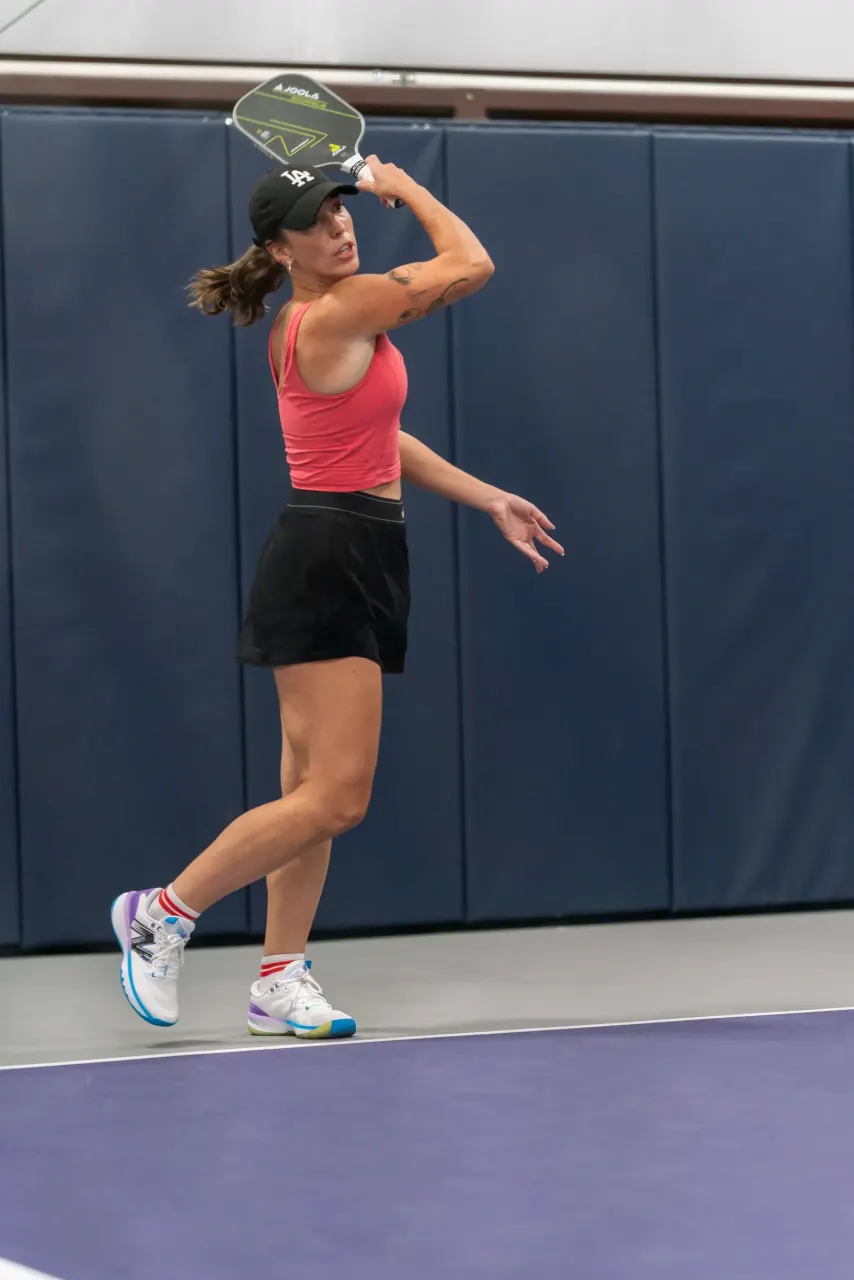
Contact high and out in front, around the eleven o’clock position relative to your body — not directly above your head.
Compact motion. Think of throwing a ball. Elbow leads, paddle accelerates through contact, wrist snaps down through the ball.
Rotate through it. Chest turns to face the net as you swing. Arm-only overheads have neither power nor consistency.
Don’t try to kill it. A controlled overhead at two-thirds pace placed at someone’s feet wins the point far more often than a full swing that flies long. Pace is the least important variable here.
Where to aim
The best overhead target is at the feet of the closest opponent, not the baseline.
This is counterintuitive — instinct says hit it as deep and hard as possible. But a ball driven down at someone’s feet has nowhere good to go: it kicks up awkwardly and they have no time. A smash aimed at the baseline has a long way to travel, needs more margin, and gives them time to run it down.
Second-best: the sharp angle into an open sideline, if an opponent has drifted.
Worst: hard and flat straight at a set opponent’s paddle, chest high. That’s a ball they can block.
Defending the smash
The mirror image is worth knowing, and it’s exactly why aiming at feet matters.
When someone is about to smash:
- Back up a step and get low. Paddle out in front, roughly chest height.
- Expect it at your feet. Good players aim there, and being low already means you can block it.
- Block, don’t swing. Soft hands and a still paddle absorb pace. A swing at a smash goes anywhere.
- Aim your block into the kitchen to reset the point rather than trying to counter-attack.
More on absorbing pace in how to reset in pickleball and the punch volley.
When not to hit an overhead
When you’re off balance or falling backward. Let it bounce.
When the lob is genuinely good — deep, high, over your backhand shoulder. Retreat, let it bounce, hit a defensive shot, and stay in the rally. See how to defend the lob.
When it’s your partner’s ball. Overheads cause more partner collisions than any other shot, because both players track the high ball. Call it early and loudly.
Drills
Feed and finish. Partner lobs from the kitchen; you smash at a target placed at their feet. Twenty reps focused on getting behind the ball, not on power.
Deep lob retreat. Partner alternates hittable lobs and deep ones. You decide: smash or let it bounce. The decision is the drill.
Block the smash. Reverse roles. Partner smashes from mid-court at controlled pace; you block into the kitchen. Builds the soft hands that make you hard to put away.
Frequently Asked Questions
How do you hit an overhead smash in pickleball?
Turn sideways immediately, move behind the ball rather than under it, contact it high and out in front with a compact throwing motion, and rotate your chest through the shot.
Where should you aim a pickleball overhead?
At the feet of the closest opponent. A ball at the feet is much harder to handle than a smash driven toward the baseline, which needs more margin and gives opponents time.
Why do I keep missing overheads in pickleball?
Usually footwork. If the ball ends up directly above or behind you there’s no margin. Turn sideways early and get behind the ball so you can drive up and through it.
Should you always smash a lob?
No. If you’re off balance, falling backward, or the lob is deep over your backhand shoulder, let it bounce and play a defensive shot instead.
How do you defend against an overhead smash?
Back up a step, get low, hold the paddle out in front at chest height, and block with soft hands rather than swinging. Expect the ball at your feet.