


Few things stop new pickleball players faster than the scoring. You hear “5-2-1” called out, the server keeps switching sides, and somehow only one team can put points on the board. It feels like a secret code — until someone breaks it down.
That is exactly what this guide does. We will walk through it step by step, from why only the serving team scores to how to call a three-number score without hesitating, so the next time you step on court you can keep score with confidence instead of guessing.
Everything below describes traditional side-out scoring, which is what you’ll play in virtually every recreational game and in most tournaments. Rally scoring is a different format, and we cover it separately at the end.
The one rule that explains everything
Only the serving team can score a point.
That single sentence is the source of nearly all beginner confusion, and once it lands, the rest of the system follows from it. If your team is receiving and you win the rally, you do not score. You win the serve. Getting the serve back is called a side out.
So a rally has two possible outcomes:
- The serving team wins the rally → they score a point and serve again.
- The receiving team wins the rally → no point is scored; the serve moves on.
This is why a game can sit at 4-2 for several rallies in a row. Points only appear when the team holding the serve wins.
Games are to 11, win by 2
A standard game is played to 11 points, and you must win by at least 2. At 10-10, play continues until one team leads by two — 12-10, 13-11, and so on. There is no cap in recreational play.
Tournaments sometimes use games to 15 or 21, still win by 2, usually in medal rounds or shortened formats. If you’re playing an organized event, check the format sheet rather than assuming — but if nobody has told you otherwise, it’s 11.
How to call the score in doubles
In doubles the score is called as three numbers, in this order:
serving team’s score — receiving team’s score — server number (1 or 2)
So “5-2-1” means the serving team has 5, the receiving team has 2, and the first server is serving. The server calls the score out loud before every serve, and calling it correctly is genuinely part of the game — it keeps four people synchronised.
Server 1 and server 2
In doubles, both partners get to serve before the serve passes to the other team. When the first server loses a rally, the serve goes to their partner (server 2). When server 2 loses a rally, it’s a side out and the other team serves.
Why every game starts at 0-0-2
The team serving first only gets one server in the opening service turn, instead of two. Without that adjustment, serving first would be a real advantage.
So the first server of the game is designated server 2, and the opening call is “0-0-2”. When that player loses the rally, it’s an immediate side out. From then on, both teams get both servers as normal.
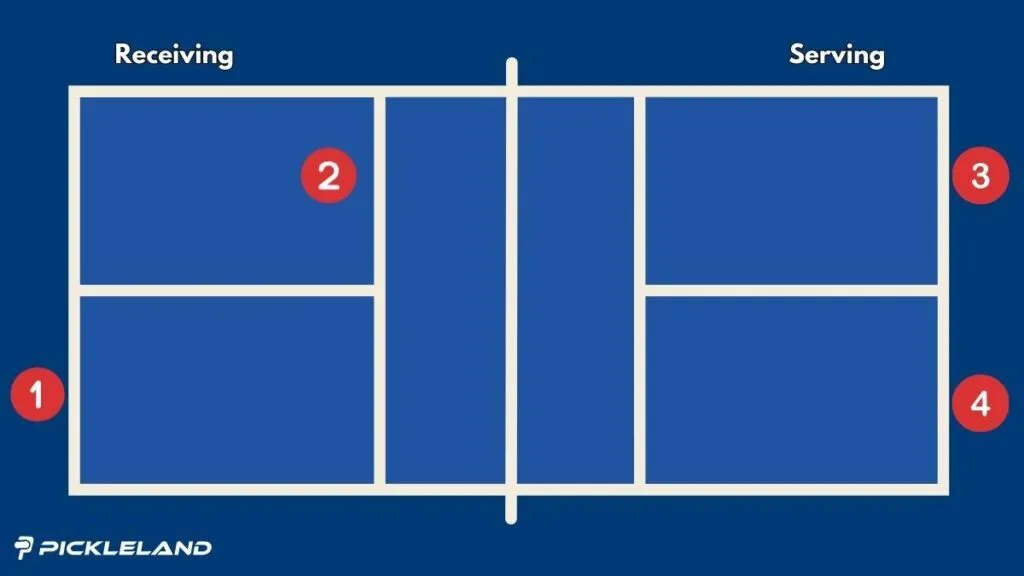
Even, odd, and where to stand
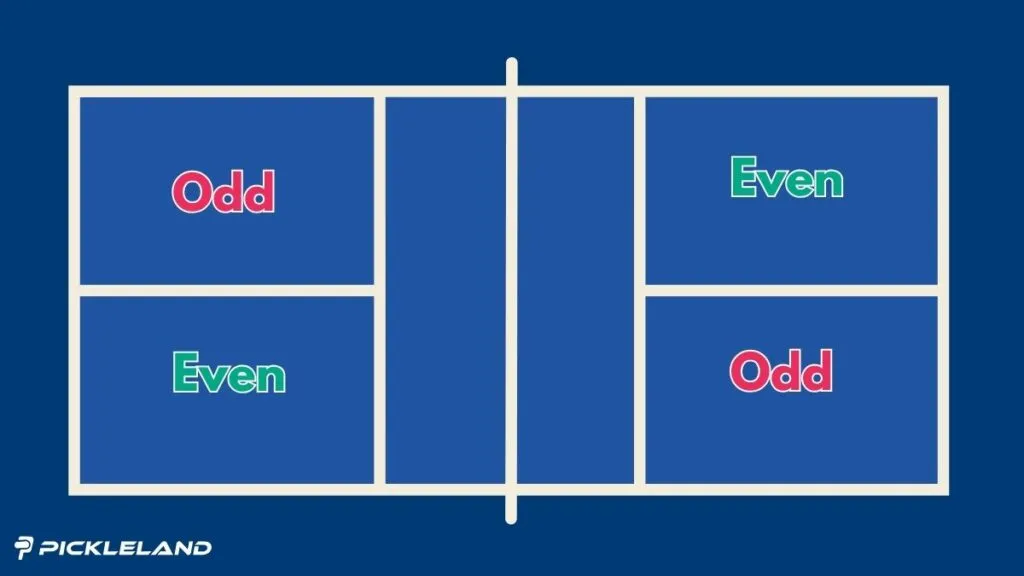
The right service court is the even court; the left is the odd court.
Your position is determined by your own team’s score:
- Team score is even (0, 2, 4…) → the player who started the game on the right serves from the right.
- Team score is odd (1, 3, 5…) → that player has moved, and serves from the left.
Partners do not swap sides after a side out or after losing a rally. You only switch sides with your partner when your team scores — the server and partner trade places, then the same server serves again from the new side.
This is also the built-in error check. If you’re serving and your team’s score is even but you’re standing on the left, something has gone wrong earlier in the game.
Singles scoring is simpler
In singles the score is called as two numbers: your score, then your opponent’s. There’s no server number, because there’s only one server per side.
Positioning follows the same even/odd logic: serve from the right when your score is even, from the left when it’s odd. And the same core rule applies — you only score while serving.
What ends a rally
A rally ends when a team commits a fault. The common ones:
- The ball lands out of bounds.
- The ball fails to clear the net.
- The ball bounces twice on one side before being returned — you get one bounce, not two.
- A player volleys while touching the non-volley zone or its lines, or their momentum carries them in afterward. See pickleball kitchen rules.
- A serve lands outside the correct diagonal service court.
- The two-bounce rule is broken: the serve must bounce, and the return of serve must bounce, before anyone may volley.
If the serving team commits the fault, no point is scored and the serve moves on. If the receiving team commits it, the serving team scores.
Terms you’ll hear on court
Serve — the shot that starts a rally, hit diagonally to the opponent’s service court.
Fault — any rules violation that ends the rally.
Side out — the serve passing to the other team, after both partners in doubles have lost their service turn.
Even/odd court — the right service court is even, the left is odd.
Second serve — often called out as part of the score to signal that the serving team is on its second server.
Rally scoring: the other format
In rally scoring, a point is awarded on every rally, to whichever team wins it, regardless of who served. Games are typically shorter and the clock more predictable, which is why broadcast and league formats favour it.
As of the 2026 USA Pickleball rulebook, the game-winning point in rally scoring may also be won by the receiving team — the old requirement that game point be scored while serving was removed. Traditional scoring was not affected.
So if someone tells you the receiving team can score, they’re describing rally scoring. Under traditional scoring, they cannot. Full detail in our guide to rally scoring in pickleball, and see 2026 pickleball rule changes for what else changed this year.
Keep going
- Pickleball Rules Explained: A Beginner’s Guide
- Pickleball Serve Rules: Master The Basics And Improve Your Game
- What Is Pickleball: History, Gameplay, Rules, And Gear
- Pickleball Kitchen Rules: The Non-Volley Zone Explained
- Pickleball Singles Rules
- What Is Rally Scoring In Pickleball?
Frequently Asked Questions
Can you only score points when serving in pickleball?
Under traditional side-out scoring, yes — only the serving team can score. If the receiving team wins a rally, they win the serve rather than a point. The exception is rally scoring, a separate format in which the winner of each rally scores regardless of who served.
How do you score a point in pickleball?
The serving team scores when the receiving team commits a fault: hitting the ball out of bounds, failing to clear the net, letting it bounce twice, volleying from inside the non-volley zone, or breaking the two-bounce rule. If the serving team commits the fault instead, no point is scored and the serve moves on.
Is a pickleball game played to 11 or 15?
Standard games are played to 11, win by 2. Some tournaments use 15 or 21, also win by 2, typically in medal rounds or abbreviated formats. Recreational play is almost always 11.
What do the three numbers in a pickleball score mean?
Serving team’s score, receiving team’s score, then the server number — 1 or 2. “7-4-2” means the serving team has 7, the receiving team has 4, and the second server is serving.
Why does the score start at 0-0-2?
The team serving first gets only one server in the opening service turn, so that serving first isn’t an advantage. That player is designated server 2, making the opening call “0-0-2.” After the first side out, both teams get both servers normally.
When do partners switch sides in doubles?
Only when your team scores a point. The server and their partner trade places and the same player serves again from the new side. You do not switch after losing a rally or after a side out.
Which side do I serve from?
Serve from the right (even) court when your team’s score is even, and from the left (odd) court when it’s odd. This works as a self-check: if your score is even and you’re on the left, a mistake was made earlier in the game.