
Ask most recreational players which wing gives them trouble and the answer comes fast: the backhand. It’s the shot people run around, slap at, or half-volley into the net rather than hit on purpose. And it’s not because the backhand is inherently harder — it’s because almost nobody spends real practice time on it. The forehand gets all the reps in casual rallies; the backhand gets whatever’s left over, usually a panicked lunge.
The good news is the backhand is one of the fastest strokes to fix once you isolate what’s actually going wrong. Grip, contact point, and a bit of deliberate practice close most of the gap in a few sessions. Here’s the full breakdown — one-handed and two-handed, at the net and off the bounce — plus the drills that actually build it.
Why the Backhand Breaks Down for Most Players
The forehand feels natural because your arm swings across your body in a motion close to how you’d throw or swat something — it matches movements you’ve made your whole life. The backhand asks your arm to swing the opposite direction, with your shoulder rotated away from the ball instead of into it. That’s an unfamiliar pattern for most adults picking up a paddle for the first time, which is exactly why it needs deliberate reps instead of just “playing it out.”
The second problem is grip switching. Players who use an Eastern forehand grip (paddle face rotated toward the target hand) have to physically turn the paddle in their hand to hit a clean backhand, and there’s rarely time mid-rally to do that. The fix for both problems starts in the same place: the grip.
Pick One Grip That Works for Everything
The continental grip is the standard for a reason: it’s the one grip that lets you hit forehands, backhands, volleys, and dinks without changing your hand position between shots.
To find it:
- Hold the paddle so one edge points straight up and one straight down — like you’re about to chop wood.
- That’s roughly 0 degrees on the grip. Rotate the paddle slightly (about a quarter turn from a full Eastern forehand grip) so the base knuckle of your index finger sits near the top bevel, like you’re holding a hammer.
- Keep the same grip through your forehand, backhand, and volleys — you shouldn’t feel your hand adjust at all when the ball switches sides.
Rotating too far toward an Eastern forehand grip is the single biggest reason backhands feel awkward: the paddle face ends up open or closed at contact instead of square, and players compensate with wrist manipulation that’s inconsistent under pressure.
The One-Handed Backhand
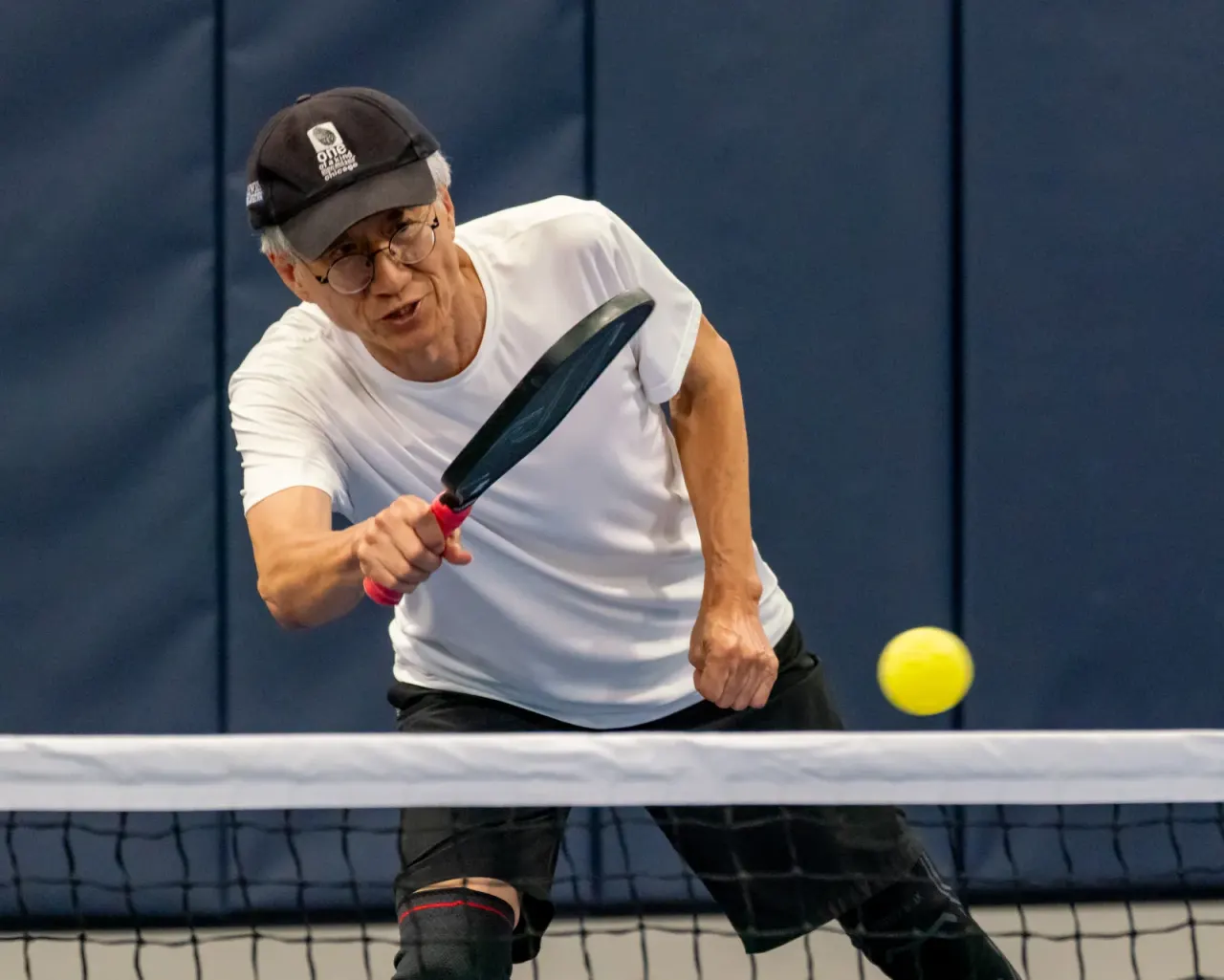
Most players start here because it mirrors the forehand motion and keeps your reach long — useful for anything wide.
Setup: Turn your shoulders sideways to the net (your back shoulder points roughly at your target) rather than staying square. This shoulder turn is what generates the swing, not your wrist.
Contact point: Strike the ball out in front of your body, not beside or behind it. A backhand hit even with or behind your hip almost always sails wide or into the net because the paddle face is still opening or closing through its arc at that point — square contact only happens briefly, out front.
Swing path: Keep the backswing short and compact — turn the shoulders back, then swing forward low-to-high with the paddle leading slightly ahead of your hand. A long, looping backswing is the most common power leak and timing killer on this shot.
Follow-through: Let your arm extend toward the target and finish with the paddle face still roughly square, not rolled over. Rolling the paddle face at the finish is a habit borrowed from other racket sports and it kills control in pickleball.
The Two-Handed Backhand
A two-handed backhand — your non-dominant hand added just above your dominant hand on the grip — trades reach for stability and power, and it’s a completely legitimate option in pickleball (borrowed straight from tennis, where it’s just as common as the one-hander).
When it helps: Players with less shoulder rotation or upper-body strength often find two hands gives them more consistent contact, especially on harder-driven balls. It also adds natural topspin, since the off-hand helps brush up through the ball.
The tradeoff: Two hands shortens your reach by several inches, which matters on wide balls and at the net, where a one-hander (or a simple backhand slice) can save a point a two-hander can’t reach.
Mechanics: Your non-dominant hand does more of the work than people expect — it guides the paddle face and adds most of the topspin brushing action, while your dominant hand mostly stabilizes. Rotate your shoulders and hips away from the net on the backswing, then rotate through toward the target on contact.
Many players use one hand for volleys and dinks (where reach and touch matter more) and two hands only for backhand drives off the bounce. That split isn’t indecisive — it’s using the right tool for each shot.
The Backhand at the Kitchen Line
A backhand dink and a backhand drive use almost opposite mechanics, and conflating them is a common source of errors.
For a backhand dink, keep the same soft-hands approach as your forehand dink: continental grip, minimal wrist movement, the shot powered by a small shoulder lift rather than an arm swing. Because reach matters more than power here, most players are better off staying one-handed at the net even if they two-hand their drives. See our guide to improving your dinks for the full mechanics of soft-game control — the same principles apply on the backhand side, just with the shoulder turned rather than square to the net.
For a backhand volley away from the kitchen (mid-court or defending a hard drive), shorten your swing even further — a firm “block” with the paddle face rather than a full stroke. Trying to generate power on a backhand volley is how mishits and pop-ups happen; let the incoming pace do the work.
Backhand Return of Serve
The return of serve is the single most predictable ball in the game — you know it’s coming and roughly where — which makes it the easiest place to build backhand confidence deliberately.
Set up in your continental grip before the serve is struck, not after. Players who wait to see the ball before adjusting their grip lose the split second that makes the difference between a clean backhand and a rushed one. If the serve comes to your backhand side, turn your shoulders early and take the ball out in front, following the same setup as a standard one-handed backhand.
Common Pickleball Backhand Mistakes
1. Contact too far back. Hitting the ball beside or behind your body instead of out in front is the single most common flaw — it usually sends the ball wide or into the net because the paddle face isn’t square yet.
2. Grip creep toward Eastern forehand. If your backhands keep going long or wide inconsistently, check your grip first. A hand that’s drifted toward a forehand grip makes the paddle face angle unpredictable on the backhand side.
3. Running around the backhand. Sprinting to hit everything with a forehand instead of committing to the backhand feels safer short-term but stalls development completely — and opponents will find and target the weakness once they notice the pattern.
4. Overswinging for power. A long, arm-driven swing on the backhand is far less reliable than a compact, shoulder-turn-driven one. Consistency on the backhand comes from a short, repeatable stroke, not from muscling the shot.
5. Rolling the paddle face at the finish. Letting the paddle roll over through contact (a habit from other racket sports) closes the face and sends backhands into the net. Finish with the face still roughly facing your target.
Drills to Build a Reliable Backhand
Wall or fence reps: Standing a few feet from a wall or fence, hit continuous soft backhands, focusing only on grip and contact point out in front. No score, no opponent — just grooving the motion.
Cross-court backhand-to-backhand rally: With a partner, rally cross-court hitting backhand to backhand only. This forces repeated backhand contact instead of the one or two you’d get in a normal point, which is where the pattern actually sets.
Backhand-only games to 11: Play a casual game where you’re only allowed to hit backhands (your partner can hit anything). It feels artificial for the first few points and becomes a genuinely useful pressure-test by the end of the game.
Ball machine drills: A ball machine set to feed consistently to your backhand side removes the guesswork of a live rally and lets you focus purely on repetition. Available at Pickleland for $15/hr — set the feed to one predictable spot and just groove contact point for 15–20 minutes at a time.
Video check: Record ten backhands from the side. Most players are surprised to see how far back or how late they’re actually making contact — a flaw that’s nearly impossible to feel in real time but obvious on video.
Fix Your Backhand at Pickleland
Reading about grip and contact point gets you most of the way there, but a coach watching your specific swing live closes the gap fastest — especially for a shot like the backhand, where a small grip or timing flaw is hard to self-diagnose. At Pickleland (9 indoor courts at 21427 Martin Ln, Pflugerville), our coaches run group clinics ($30–$60) and private lessons ($80–$150/hr) that can zero in on your backhand specifically, and members get access to the ball machine for solo drill time between sessions. See memberships or book a clinic to get started.
Frequently Asked Questions
Should I use a one-handed or two-handed backhand in pickleball?
Either is legitimate. A one-handed backhand gives you more reach, which matters most at the net for dinks and volleys. A two-handed backhand adds stability and topspin on drives, which helps players with less shoulder rotation or upper-body strength. Many players mix both: one hand at the kitchen line, two hands on backhand drives off the bounce.
Why does my pickleball backhand keep going into the net or wide?
The two most common causes are contact point (hitting the ball beside or behind your body instead of out in front) and grip (your hand drifting toward an Eastern forehand grip, which leaves the paddle face open or closed at contact). Fix the contact point first, then double-check the grip.
What grip is best for a pickleball backhand?
The continental grip. It’s the one grip that works for forehands, backhands, volleys, and dinks without needing to switch your hand position mid-rally, which matters because there’s rarely time to adjust your grip during a fast exchange.
How do I stop running around my backhand?
Commit to hitting it in practice games and drills first, in lower-pressure reps, rather than trying to fix it live in competitive points. A backhand-only practice game or a cross-court backhand rally with a partner builds the pattern faster than avoiding the shot and hoping it improves on its own.
How long does it take to fix a weak pickleball backhand?
Most players notice a real difference within a few focused practice sessions, because the fix is usually mechanical (grip and contact point) rather than a matter of raw athleticism. Deliberate reps — a wall drill, a backhand-only game, or a ball machine set to feed your backhand — improve it far faster than picking it up incidentally during regular open play.
Also read: