

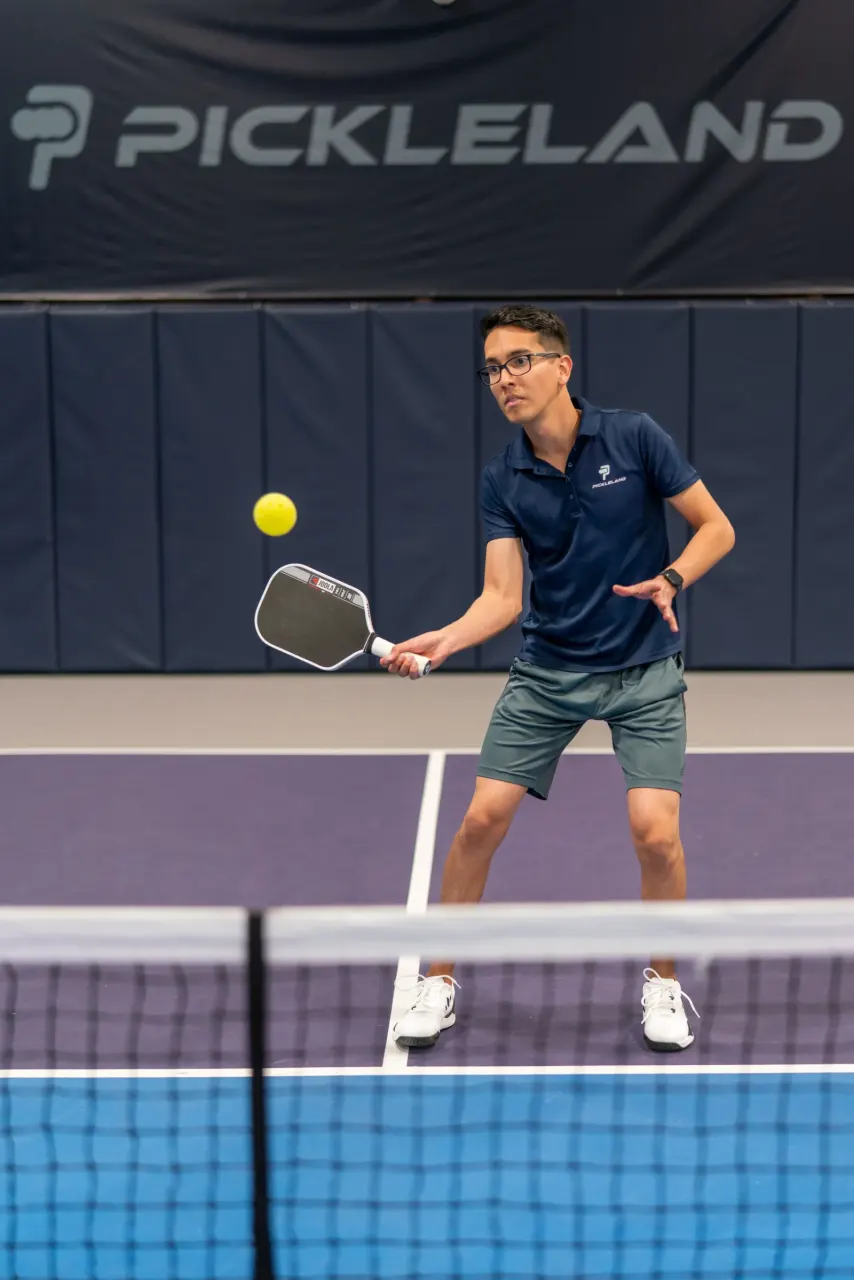
Most players are attackable on the backhand side, and they know it — so they dink defensively from there and wait to get to a forehand. The backhand flick changes that. It’s a short, wrist-driven speed-up that lets you attack from the side opponents think is safe.
What it is
A flick is a compact attack generated mostly by wrist and forearm rotation rather than a full swing. On the backhand side it’s especially useful because the backhand has a natural range of wrist motion that produces surprising pace from a very short motion.
It’s a specific kind of speed-up: faster to execute, less telegraphed, and available from a lower contact point than a forehand attack.
Why it works
It’s disguised. A backhand dink and a backhand flick start identically. Opponents cannot read which is coming until contact, unlike a forehand attack that requires a visible backswing.
Nobody expects it. Players attack the backhand precisely because they assume it can’t hurt them. A team that keeps dinking to your backhand is offering you free attacking balls once you can flick.
It’s fast. The short motion means less time for opponents to react, even at moderate pace.
It changes how you get played. Once opponents know your backhand bites, they stop feeding it, which means more balls to your forehand. The threat is worth more than the shot.
The technique
Contact point out front and slightly to your backhand side. Late contact kills the flick — the wrist has nowhere to go.
Loose wrist. Essential. The flick is wrist rotation, so a tight grip removes the whole mechanism. Grip pressure around three or four out of ten until contact, firming slightly through the ball.
Paddle face slightly closed, path low to high. You need topspin to keep an attacked ball in the court. This is a compact version of the roll volley motion.
Almost no backswing. The disguise is the value. If you take the paddle back, you’ve announced it.
Snap through with the wrist and forearm, finishing high and across your body. The forearm supinates as the wrist releases.
Stay low. Standing up as you flick sends the ball up.
When to pull the trigger
The ball is at or above net height. The single most important condition. From below the net, a flick becomes a pop-up.
The ball is slightly out front and you’re balanced. Reaching for a flick doesn’t work.
Your opponent is leaning or off balance, or has just been pulled wide by a crosscourt dink.
They’ve dinked to your backhand three times in a row and expect a fourth dink back.
Not when the ball is below net height, when you’re stretched, or when your partner is out of position and can’t cover the counter.
Where to aim
At the opponent’s right hip (for a right-handed opponent). The hardest ball in pickleball to defend — the paddle has to travel across the body with no natural stroke.
At the middle, low. Creates hesitation between two players and gives them a low ball.
Straight at the closer opponent’s paddle shoulder. Short distance, minimum reaction time.
Not the sidelines, and not deep at the baseline. A flick is a pressure shot, not a winner — you’re forcing a weak reply, and your next ball wins the point.
Expect the counter
Because a flick is fast but not overwhelming, good opponents will get a paddle on it. Assume the ball is coming back and come back harder.
The most common way to lose a point after a good flick is admiring it. Flick, then immediately reset your paddle to ready position out front and expect a fast ball. See the punch volley.
Defending against one
Paddle up, out front, always. A flick gives you no time to raise your paddle from your hip.
Watch their contact height, not their backswing. There’s no backswing to read. If they’re taking a ball above net height on the backhand side, a flick is live.
Don’t feed the backhand of someone who can flick. Obvious once you know, but it takes players a long time to adjust.
Block, don’t swing. Soft hands, still paddle, reset it into the kitchen.
Drills
Flick off a feed. Partner feeds soft balls at net height to your backhand from the opposite kitchen. Flick each one at a target on their forehand hip. Focus on the wrist, not the arm.
Dink until attackable. Backhand crosscourt dink rally. Flick the moment a ball comes back above net height. Trains recognition, which is the hard part.
Flick and counter. You flick, partner blocks it back firm, you punch the counter. Builds the habit of expecting the reply.
Frequently Asked Questions
What is a backhand flick in pickleball?
A compact, wrist-driven speed-up from the backhand side, used to attack a ball at or above net height with minimal backswing so the shot stays disguised.
When should you hit a backhand flick?
When the ball is at or above net height, you’re balanced with contact out front, and ideally when your opponent is off balance or expecting another dink. Never from below net height.
How do you generate power on a backhand flick?
Through wrist and forearm rotation with a loose grip, not a big swing. Keep the grip light until contact, brush low to high for topspin, and finish high across your body.
Where should you aim a backhand flick?
At a right-handed opponent’s right hip, low at the middle seam, or at the near opponent’s paddle shoulder. It’s a pressure shot to force a weak reply, not an outright winner.
How do you defend a backhand flick?
Keep your paddle up and out in front at all times, since there’s no backswing to read, and watch their contact height instead. Block with soft hands rather than swinging, and stop dinking to that backhand.