

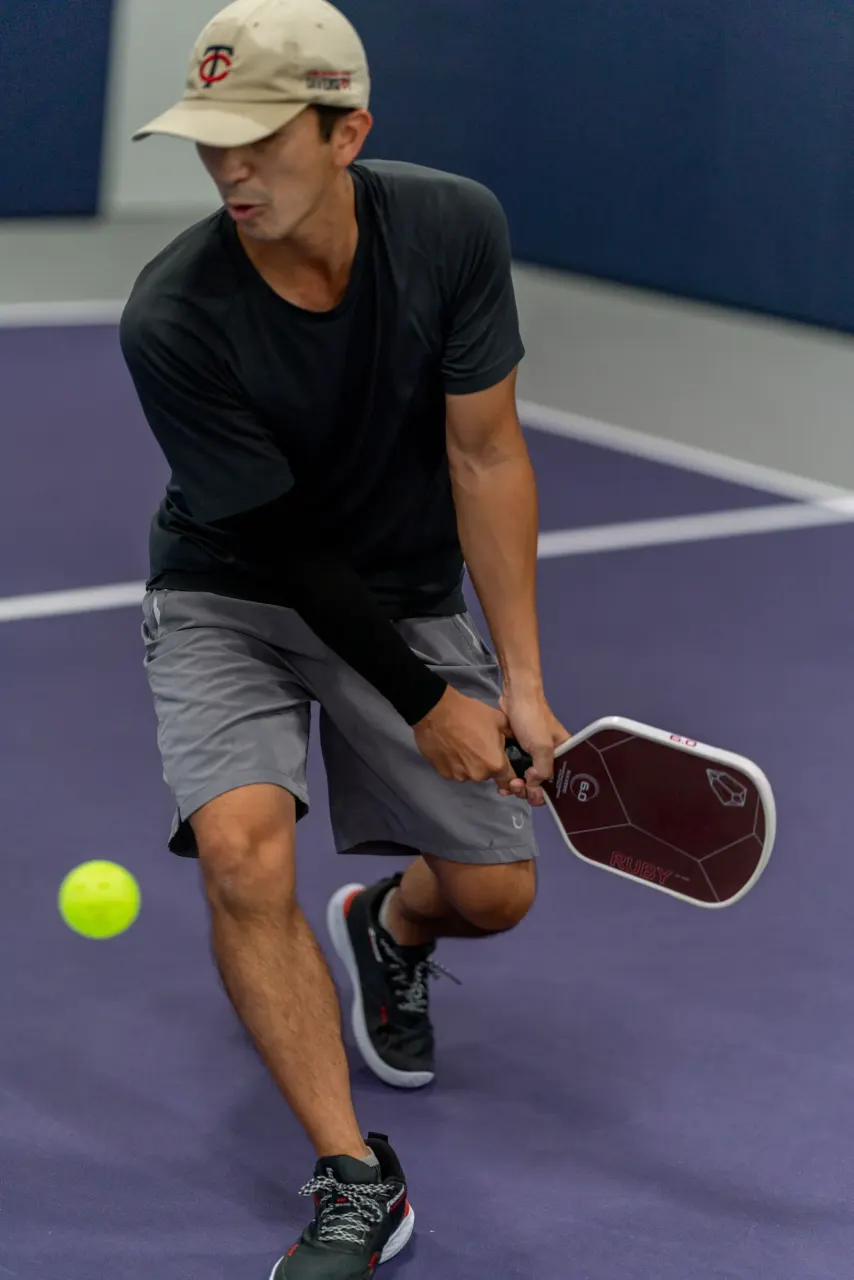
Grip size gets less attention than weight or core thickness, and it probably shouldn’t. A grip that’s wrong changes how much wrist you can use, how tightly you hold the paddle, and how much strain lands on your forearm.
Common grip sizes
Most pickleball paddles fall between 4 and 4.5 inches in circumference:
| Size | Who it typically suits |
|---|---|
| 4 in | Small hands; many juniors |
| 4 1/8 in | Small — common for women and smaller hands |
| 4 1/4 in | Standard — the most common size and the safest default for most adult men |
| 4 3/8 in | Large — useful for hands longer than about 4 inches |
| 4 1/2 in | Rare — mostly former tennis players who prefer a thick grip |
Two ways to measure
The ruler test. Open your paddle hand, palm up. Measure from the middle crease of your palm — the bottom lateral crease of the three that run across it — straight up to the tip of your ring finger. That measurement in inches is approximately your ideal grip circumference. Most people land between 4 and 5 inches.
The index finger test. Hold a paddle in your normal grip. Slide the index finger of your other hand into the gap between your fingertips and the base of your palm. It should fit comfortably — snug but not squeezed. Extra room means the grip is too big; if it won’t fit, the grip is too small.
The finger test is the more practical one, because you can do it in a shop with the actual paddle.
Why too big is worse than too small
Here’s the rule that decides most purchases: when in doubt, size down.
A grip that’s too large restricts your wrist. You physically cannot rotate through the ball properly, which costs you spin on roll volleys and pace on the backhand flick. It also forces you to grip harder to stop the paddle turning, and a tight grip is directly implicated in pickleball elbow.
A grip that’s too small is a much smaller problem, because it’s fixable. One or two overgrips add roughly a sixteenth to an eighth of an inch each, letting you build up to the right size.
You cannot make a grip meaningfully smaller without shaving the handle, which is fiddly and risks the paddle. So an undersized grip is adjustable and an oversized one mostly isn’t.
Handle length matters too
Separate from circumference: handle length determines whether you can play with two hands on the paddle.
If you hit a two-handed backhand, you need a longer handle — typically around 5.5 inches or more. A short handle with a two-handed grip leaves your bottom hand hanging off the end, which costs control.
Longer handles also shift some mass toward your hand, reducing swingweight. See pickleball paddle weight.
Grip pressure is a separate variable
Even a correctly sized grip doesn’t help if you strangle it.
Most players hold the paddle far too tightly. A useful target is around four or five out of ten for the soft game — light enough that the paddle can absorb pace on resets — firming to perhaps six or seven for a punch volley or a drive.
If your forearm is tired after a session, grip pressure is a likelier cause than grip size.
Replacing your grip
Overgrips wear out, and a slick grip makes you hold tighter, which brings back every problem above.
- Overgrip: a thin wrap over the existing grip. Cheap, adds a little thickness, replace it when it goes slick or shiny.
- Replacement grip: removes and replaces the original. Use when the base grip itself is worn.
- How often: depends entirely on how much you play and how much you sweat. When it feels slick, replace it.
Frequently Asked Questions
How do I measure my pickleball grip size?
Measure from the middle crease of your palm to the tip of your ring finger — that length in inches is roughly your ideal grip circumference. Or hold a paddle and check that your other index finger fits snugly between your fingertips and palm.
What is the most common pickleball grip size?
4 1/4 inches is the most common and the safest default for most adult men. 4 1/8 inches suits many women and smaller hands.
Should I size up or down on grip size?
Down. A grip that’s too small can be built up with overgrips, while a grip that’s too large restricts your wrist, forces a tighter hold, and can’t easily be reduced.
Can the wrong grip size cause pickleball elbow?
A grip that’s too large forces you to squeeze harder to control the paddle, and that sustained tension is one recognized contributor to elbow pain, alongside technique and playing volume.
Does handle length matter in pickleball?
Yes, particularly for two-handed backhands, which need a longer handle — generally around 5.5 inches or more — so your bottom hand isn’t hanging off the end.